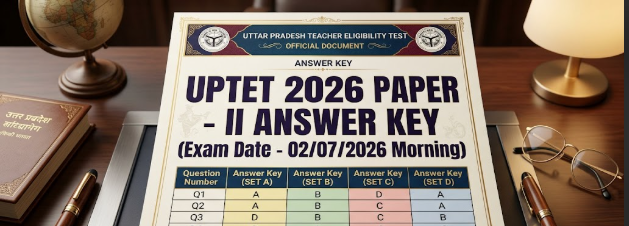
UPTET Junior : English Answer key
Language – II: English / Q. Nos. 61 to 90
(Exam Date : 02/07/2026 Morning Time)
(Exam Date : 02/07/2026 Morning Time)
61. Choose the word that belongs to the category of an abstract noun in the sentence: “Her kindness impressed everyone.”
Sahi Uttar: (D) kindness
Vyakhya: Abstract Noun un cheezon ya gunon (qualities) ko darshata hai jise hum chhu ya dekh nahi sakte, balki sirf mehsoos kar sakte hain. Is vakya me ‘kindness’ (dayaluta) ek gun hai, isliye yeh abstract noun hai. ‘Everyone’ aur ‘her’ pronouns hain aur ‘impressed’ ek verb hai.
62. Select the sentence containing a correctly used reciprocal pronoun.
Sahi Uttar: (B) The two brothers blamed each other for the incident.
Vyakhya: Reciprocal Pronoun ka istemal aapsi sambandh ya kriya ko darshane ke liye kiya jata hai. Do vyaktiyon ke liye ‘each other’ aur do se adhik ke liye ‘one another’ ka prayog hota hai. Vikalp (B) me do bhaiyon ke liye ‘each other’ ka bilkul sahi prayog kiya gaya hai. Vikalp (C) me ‘after winning’ hona chahiye tha jo ki grammatically galat hai.
63. Choose the sentence with an appropriate conjunction indicating purpose.
Sahi Uttar: (D) He studied hard so that he could qualify for the fellowship.
Vyakhya: Purpose (उद्देश्य) ko darshane ke liye ‘so that’ ya ‘in order that’ conjunction ka prayog kiya jata hai. Is vakya me kathin parishram karne ka uddeshya fellowship qualify karna hai, isliye ‘so that’ ka prayog uchit hai.
64. Select the sentence containing the correct use of a preposition with a noun.
Sahi Uttar: (A) There is no exception to this regulation.
Vyakhya: Noun ‘exception’ ke sath hamesha fixed preposition ‘to’ ka prayog kiya jata hai (“exception to something”). Isliye vikalp (A) shuddh hai.
65. Choose the word correctly formed from the root word to fit the sentence: “The manager objected to the ___________ disclosure of confidential records.”
Sahi Uttar: (C) unauthorized
Vyakhya: Vakya ke arth ke anusar, manager ne gopniya records ke “gair-kanooni ya bina anumati ke” (unauthorized) khulase par apatti (objection) jatayi. ‘Disclosure’ noun ke pehle adjective ke roop me ‘unauthorized’ sabse sateek padta hai.
66. Select the option that is the closest antonym of the word “Ascend”.
Sahi Uttar: (D) Descend
Vyakhya: ‘Ascend’ ka arth hota hai “upar chadhna” ya “aage badhna”. Iska sahi vilom (antonym) ‘Descend’ hota hai, jiska arth hota hai “neeche utarna”. Rise aur Climb iske synonyms hain.
67. Select the sentence that correctly transforms the given active voice into passive voice: “People believe that the scientist discovered a rare element.”
Sahi Uttar: (D) The scientist is believed to have discovered a rare element.
Vyakhya: “People believe that…” wale vakyon ko passive me badalte samay ‘Subject + is/are believed + to have + V3’ ka niyam lagaya jata hai agar subordinate clause past tense me ho (‘discovered’). Isliye vikalp (D) grammatically shuddh hai.
68. Choose the option that correctly completes the sentence: “The speaker’s argument lacked sufficient evidence and therefore failed to ___________ the audience.”
Sahi Uttar: (C) persuade
Vyakhya: Is vakya me ‘persuade’ (raazi karna ya manana) shabd ka prayog hona chahiye. Vikalp (B) me spelling galat hai (‘pursuade’), jabki vikalp (C) me ‘persuade’ ki spelling aur arth dono bilkul sahi hain.
69. Select the option that is the closest synonym of the word “Laconic” as used in formal English usage.
Sahi Uttar: (C) Concise
Vyakhya: ‘Laconic’ ka matlab hota hai kam shabdon me baat kehna (sankshep me). Isliye iska sabse qareebi paryayvachi (synonym) ‘Concise’ hoga. ‘Verbose’ ka arth hota hai bahut adhik shabdon ka istemal karna, jo ki iska antonym hai.
70. Choose the sentence in which the adjective and its degree are used without grammatical error.
Sahi Uttar: (D) This analytical report is superior to the previous publication.
Vyakhya: Latin adjectives jaise ‘superior’, ‘inferior’, ‘senior’, ‘junior’ ke sath comparison ke liye ‘than’ ke sthan par hamesha ‘to’ ka prayog hota hai. Saath hi, inke sath ‘more’ ka prayog karna galat hai kyunki ye pehle se hi comparative sense me hote hain. Isliye (D) sahi hai.
71. Identify the correctly punctuated sentence from the following options:
Sahi Uttar: (D) The speaker said that success requires discipline, perseverance, and hard work.
Vyakhya: Jab teen ya teen se adhik items ki list di jati hai, toh unhe alag karne ke liye commas ka prayog kiya jata hai, jisme akhiri item ke pehle ‘Oxford comma’ (, and) lagana formal English me sabse shuddh mana jata hai. Isliye (D) sahi punctuation hai.
72. Which word is the closest synonym of ‘audacious’?
Sahi Uttar: (A) Bold
Vyakhya: ‘Audacious’ ka arth hota hai saahasi, nidar ya nirlajjata ki had tak saahasi hona. Isliye iska sabse sateek synonym ‘Bold’ hai. ‘Timid’ (darpok) iska opposite hai.
73. Select the option in which the complete subject has been identified correctly.
Sentence: “Many skilled artists from different regions participated in the exhibition.”
Sentence: “Many skilled artists from different regions participated in the exhibition.”
Sahi Uttar: (B) Many skilled artists from different regions
Vyakhya: Kisi bhi vakya me verb (kriya) se pehle ka poora bhag jo kriya ko karne wale ke baare me batata hai, use Complete Subject kehte hain. Yahan verb ‘participated’ hai, isliye uske pehle ka poora hissa “Many skilled artists from different regions” complete subject hai.
74. Select the word in which the silent letter does not belong to the same sound pattern as the others.
Sahi Uttar: (D) Ghost
Vyakhya: ‘Hour’, ‘Honest’, aur ‘Heir’ in teeno shabdon me shuruat ka akshar ‘H’ bilkul silent hota hai aur vowel sound se uccharan shuru hota hai. Jabki ‘Ghost’ me ‘G’ ke sath ‘h’ milkar ek alag /ɡ/ sound banata hai, isliye iska sound pattern baki teeno se bhinn hai.
75. Choose the sentence in which the adverb expresses frequency.
Sahi Uttar: (D) He often visits the library after classes.
Vyakhya: Adverb of frequency yeh darshata hai ki koi kriya kitni baar (how often) hoti hai. Vakya (D) me ‘often’ (aksar) shabd frequency ko darsha raha hai. ‘Late’ adverb of time hai, ‘nearby’ aur ‘outside’ adverb of place hain.
76. In the sentence “You must complete the assignment today,” the verb “must” is classified as:
Sahi Uttar: (A) Modal auxiliary verb
Vyakhya: ‘Must’ ek modal auxiliary verb (sahayak kriya) hai, jo badhyata (obligation), nishchit-ta ya aavashyakta ko darshata hai aur main verb (‘complete’) ki madad karta hai.
77. Choose the sentence that maintains grammatical accuracy while conveying a polite request.
Sahi Uttar: (B) Kindly lend me your notes for a day.
Vyakhya: Imperative sentences me polite request karne ke liye ‘Kindly/Please’ ke turant baad verb ki base form (V1) ka prayog kiya jata hai, bina kisi ‘to’ ya pronoun ke jode. Isliye (B) bilkul shuddh roop hai.
78. Select the option in which the gender transformation is grammatically incorrect.
Sahi Uttar: (A) Sultan – Sultanae
Vyakhya: ‘Sultan’ ka feminine gender (stree-ling) ‘Sultana’ hota hai, na ki ‘Sultanae’. Baki sabhi options (Duke-Duchess, Emperor-Empress, Patron-Patroness) ke gender parivartan bilkul sahi hain.
79. Choose the most appropriate word to complete the sentence: “The director stated that ___________ failing to comply with the revised regulations would not be permitted to participate in the academic conference.”
Sahi Uttar: (B) anybody
Vyakhya: Conditional ya restrictive sentences me jahan sabhi par niyam lagu ho, wahan ‘anybody’ ya ‘anyone’ (jo koi bhi) ka prayog kiya jata hai. Iska arth hai ki “jo koi bhi sanshodhit niyamon ka palan nahi karega, use anumati nahi milegi”.
80. Choose the correct interrogative sentence from the given options.
Sahi Uttar: (B) Did the students submit the assignment yesterday?
Vyakhya: Jab vakya me ‘yesterday’ (beeta hua kal) jaisa nishchit past time marker diya ho, toh vakya hamesha Simple Past Tense me banta hai. Simple Past ke prashnavachak vakya me ‘Did + Subject + V1 (base form)’ ka niyam lagta hai, isliye (B) shuddh hai.
81. In the sentence “She has been reading for three hours,” the verb phrase “has been reading” represents:
Sahi Uttar: (C) Finite main verb with auxiliaries
Vyakhya: ‘has been reading’ Present Perfect Continuous tense ka roop hai jo subject ke anusar badalta hai, isliye yeh finite verb hai. Isme ‘has’ aur ‘been’ auxiliary verbs (sahayak kriya) hain aur ‘reading’ main verb hai, isliye yeh ‘Finite main verb with auxiliaries’ hai.
82. Select the sentence in which the preposition is used correctly.
Sahi Uttar: (D) The committee deliberated on the proposal for three hours.
Vyakhya: Verb ‘deliberate’ (vichaar-vimarsh karna) ke sath kisi vishay par charcha karne ke liye standard preposition ‘on’ ya ‘upon’ ka prayog kiya jata hai (“deliberate on something”). Isliye (D) sahi hai.
83. Choose the correct plural form to complete the sentence: “The committee evaluated several strict ___________ before approving the research proposals for funding.”
Sahi Uttar: (C) criteria
Vyakhya: ‘Criterion’ ek singular noun (ekvachan) hai, jiska irregular plural form (bahuvachan) hamesha ‘criteria’ hota hai. ‘Criterias’ jaisa koi shabd English grammar me nahi hota.
84. Select the sentence that correctly uses a correlative conjunction.
Sahi Uttar: (A) Neither the manager nor the employees were willing to compromise.
Vyakhya: Correlative conjunctions jode me aate hain, aur ‘Neither’ ka jodidar hamesha ‘nor’ hota hai. Saath hi, ‘Neither… nor’ ke niyam ke anusar verb sabse paas wale subject ke vachan ke anusar lagti hai. Yahan ’employees’ plural hai, isliye plural verb ‘were’ ka prayog kiya gaya hai.
85. Select the correctly reported form of the sentence: “The teacher said, ‘Let us begin the discussion immediately.'”
Sahi Uttar: (A) The teacher suggested that they should begin the discussion immediately.
Vyakhya: Jab Direct Speech me ‘Let us’ se prastav (proposal ya suggestion) diya gaya ho, toh use Indirect me badalte samay reporting verb ko ‘suggested/proposed’ me badla jata hai aur inverted commas hata kar ‘that they should + V1’ ka prayog kiya jata hai. Isliye (A) bilkul sahi hai.
86. Which sentence uses an interjection correctly?
Sahi Uttar: (D) Hurray, the team won!
Vyakhya: Interjection (jaise Hurray, Alas, Oh) ka prayog tivra bhavnaon ko vyakt karne ke liye vakya ke shuru me kiya jata hai aur iske baad ek comma ya exclamation mark (!) lagana anivarya hota hai. Vikalp (D) me iska upyog aur punctuation dono sahi hain.
87. Choose the option in which the noun changes from a Common Noun to a Proper Noun.
Sahi Uttar: (C) river → Ganga
Vyakhya: Common Noun kisi poori jaati ya varg ko darshata hai (jaise ‘river’ – nadi), jabki Proper Noun kisi vishesh vyakti, sthan ya vastu ka naam hota hai (jaise ‘Ganga’). Vikalp (C) me common noun se proper noun me badlaav sahi tarike se dikhaya gaya hai.
Read the passage and answer the questions: [Q. Nos. 88 to 90]
There was a rich industrialist who was inclined towards living a spiritual life. Often, his yearning for God was so strong, that he would weep in silence with tears of love and longing. However, he continued to live a luxurious life amid worldly comforts. One day, when he was meditating in his garden, reflecting upon the beauty of flowers and the bounty of nature, he had a mystical experience. In the deep silence of meditation, he had a vision. The vision profiled his onward journey. He saw in the vision that after the end of this earthly journey, he had embarked on a second journey. This journey was long, arduous and exhausting. It continued endlessly. And there were many obstacles he had to face on the way. The heat was sizzling and unbearable but there was no one to give him an umbrella to protect him from the harsh sun.
There was a rich industrialist who was inclined towards living a spiritual life. Often, his yearning for God was so strong, that he would weep in silence with tears of love and longing. However, he continued to live a luxurious life amid worldly comforts. One day, when he was meditating in his garden, reflecting upon the beauty of flowers and the bounty of nature, he had a mystical experience. In the deep silence of meditation, he had a vision. The vision profiled his onward journey. He saw in the vision that after the end of this earthly journey, he had embarked on a second journey. This journey was long, arduous and exhausting. It continued endlessly. And there were many obstacles he had to face on the way. The heat was sizzling and unbearable but there was no one to give him an umbrella to protect him from the harsh sun.
88. According to the passage, where was the industrialist when he had a mystical experience?
Sahi Uttar: (B) In his garden while meditating
Vyakhya: Gadyansh (passage) me spasht roop se likha hai—”One day, when he was meditating in his garden… he had a mystical experience.” Iska matlab hai ki jab woh apne bagiche me dhyan laga raha tha tab use yeh anubhav hua.
89. According to the passage, what did the vision reveal about the journey the industrialist would undertake after his earthly life?
Sahi Uttar: (C) He had to embark on a second, long and arduous journey
Vyakhya: Passage ke anusar, unke vision (drishya) ne yeh dikhaya ki prithvi ke jeevan ke baad unhe ek doosri lambi aur kathin yatra (‘second journey was long, arduous and exhausting’) par nikalna hoga.
90. Why did the industrialist often weep in silence according to the passage?
Sahi Uttar: (D) He longed for God and felt love
Vyakhya: Gadyansh ki shuruati panktiyon me diya gaya hai—”Often, his yearning for God was so strong, that he would weep in silence with tears of love and longing.” Iska arth hai ki Ishwar ke prati tivra prem aur unhe paane ki ikchha ke karan woh aksar rote the.